

Creatine dosage isn’t one-size-fits-all. While you’ve probably seen recommendations ranging from 3 to 5 grams per day, the right amount depends on factors such as your body weight, activity level, fitness goals, and whether you’re following a loading phase. Taking too little may slow your progress, while taking more than your body needs doesn’t necessarily provide additional benefits.
Research over the past two decades has shown that women can safely use creatine to support strength, exercise performance, recovery, and lean muscle development when it’s taken in appropriate amounts. However, many women still have questions about daily dosage, loading protocols, rest-day use, hydration, and how to adjust intake based on their individual needs.
Whether you’re just starting creatine or want to make sure you’re using it correctly, this guide explains exactly how much creatine women should take, when to take it, and how to avoid common dosing mistakes. If you’re new to supplementation, you may also find our complete Creatine for Women guide helpful before choosing the right dosage for your goals.
Quick Facts About Creatine Dosage for Women
| Factor | Recommendation |
| Standard Daily Dose | 3–5 grams |
| Loading Phase | Optional |
| Maintenance Dose | 3–5 grams daily |
| Best Creatine Form | Creatine Monohydrate |
| Rest Days | Continue daily intake |
| Timing | Any consistent time of day |
| Hydration | Increase daily water intake |
| Suitable For | Beginners, active women, athletes, older women |
| Evidence Level | Strong scientific support |
Table of Contents
- What Is the Recommended Creatine Dosage for Women?
- Should Women Take 3 g or 5 g of Creatine?
- Do Women Need a Loading Phase?
- Maintenance Dosage Explained
- Creatine Dosage by Body Weight
- Creatine Dosage for Beginners
- Creatine Dosage for Female Athletes
- Creatine Dosage for Women Over 40
- Should You Take Creatine on Rest Days?
- Common Creatine Dosage Mistakes
- Creatine Dosage Calculator
- Hydration Tips While Taking Creatine
- Frequently Asked Questions
What Is the Recommended Creatine Dosage for Women?
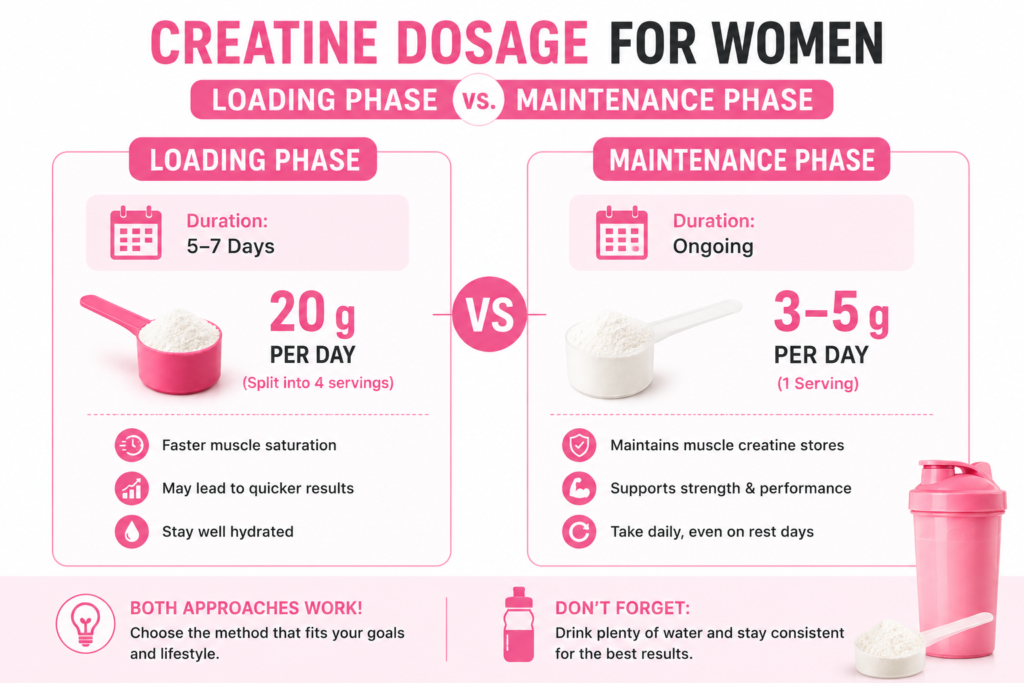
For most healthy women, the recommended creatine dosage is 3 to 5 grams per day. This amount has been widely used in scientific research and is considered effective for increasing muscle creatine stores, supporting strength gains, and improving recovery without requiring excessive supplementation.
Unlike some sports supplements that require complex dosing schedules, creatine works by gradually increasing the amount of stored phosphocreatine inside your muscles. Once these stores become saturated, your body only needs a small daily maintenance dose to keep them elevated.
Most women don’t need to adjust their dosage every day. Instead, consistency is more important than taking creatine at a specific time or increasing the amount unnecessarily.
Several factors can influence your ideal daily intake, including:
- Body weight
- Muscle mass
- Training intensity
- Exercise frequency
- Performance goals
- Whether you complete a loading phase
For recreational exercisers, fitness enthusiasts, and women looking to support overall performance, 3 grams per day may be sufficient. Women with greater muscle mass, higher training volumes, or competitive athletic goals often benefit from 5 grams per day to maintain optimal creatine stores.
Rather than focusing on taking the highest possible dose, aim to choose a consistent amount that matches your training routine and continue taking it every day, including rest days.
[IMAGE: creatine-dosage-for-women-guide.webp | Alt: “Creatine dosage for women measured with a scoop beside a glass of water”]
Why Does Creatine Dosage Matter?
Many people assume that taking more creatine will produce faster or better results. In reality, your muscles can only store a limited amount of creatine. Once those stores are full, any excess is simply excreted by your body.
Using the correct dosage helps you:
- Reach optimal muscle creatine levels efficiently.
- Support strength and power during exercise.
- Improve recovery between training sessions.
- Avoid unnecessary supplement waste.
- Follow evidence-based recommendations.
Taking less than the recommended amount may delay muscle saturation, while taking significantly more doesn’t typically improve performance for healthy adults.
Another important consideration is long-term consistency. Creatine isn’t designed to work like a stimulant that produces immediate effects after a single serving. Instead, it gradually increases the availability of phosphocreatine, which your muscles use to regenerate ATP—the primary energy source for short, high-intensity activities.
That’s why following a consistent daily routine is more beneficial than frequently changing your dosage.
What Factors Affect Creatine Dosage?
Although most women can follow the standard recommendation of 3–5 grams per day, individual factors may influence where you fall within that range.
Body Weight
Women with greater body weight or more lean muscle mass generally store more creatine in their muscles than smaller individuals. This means some active women may benefit from the upper end of the recommended dosage range.
Activity Level
Your training routine also plays an important role.
If you participate in:
- Strength training
- CrossFit
- Sprinting
- HIIT workouts
- Competitive sports
Your muscles may use phosphocreatine more frequently, making consistent supplementation especially valuable.
Women who exercise occasionally or focus on light recreational activity can often maintain adequate creatine stores with a lower daily dose.
Fitness Goals
Your goal can also influence your supplementation strategy.
For example:
- Building strength
- Increasing power output
- Supporting muscle growth
- Improving workout recovery
- Enhancing athletic performance
may justify using the higher end of the recommended dosage range.
On the other hand, women taking creatine primarily for general wellness or healthy aging may not require as much.
Loading Phase
Whether or not you complete a loading phase also affects how quickly your muscles become saturated with creatine.
Some women choose to load for faster results, while others prefer a steady daily intake without loading. Both approaches can be effective when used correctly, and we’ll explain the advantages and disadvantages of each in the next section.
By understanding these factors, you can choose a creatine dosage that matches your body, training habits, and long-term goals instead of relying on generic recommendations.
Creatine Dosage for Women Based on Your Fitness Goals
Choosing the right creatine dosage for women isn’t only about body weight. Your fitness goals also influence how much creatine you may need each day. While most healthy women benefit from 3–5 grams daily, someone training for strength or athletic performance may have different needs than someone exercising for general wellness.
If your goal is improving strength, building lean muscle, or supporting high-intensity workouts, the upper end of the recommended dosage range is often appropriate. Women who are new to resistance training or exercise primarily for overall health may achieve excellent results with a lower daily intake.
Understanding your personal fitness objective helps you follow a creatine dosage for women plan that supports your long-term progress without taking more than necessary.
Should Women Take 3 g or 5 g of Creatine?
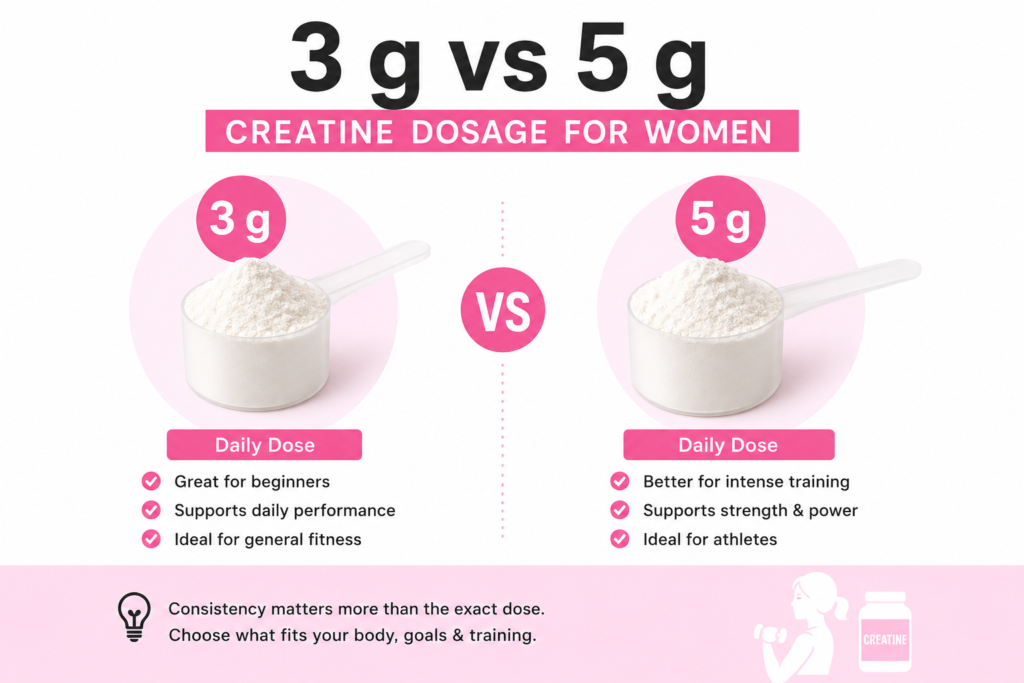
One of the most common questions women ask after deciding to use creatine is whether 3 grams or 5 grams per day is the better choice. The answer depends on your body size, activity level, muscle mass, and fitness goals rather than a single “perfect” number.
Scientific research has consistently shown that both 3 g and 5 g daily can be effective. The key difference is how quickly your muscles become saturated with creatine and how much creatine your body needs to maintain those stores over time.
For many women, 3 grams per day provides enough creatine to gradually increase muscle stores, especially if they exercise recreationally or have a smaller body frame. Women who perform intense resistance training, high-intensity interval training (HIIT), CrossFit, or competitive sports often benefit from 5 grams per day because of their higher training demands.
Rather than assuming that more is always better, think about which dosage best matches your lifestyle and training routine.
When 3 Grams Per Day May Be Enough
A daily intake of 3 grams is often suitable if you:
- Are new to creatine supplementation.
- Exercise two to four times per week.
- Have a smaller body size or lower lean muscle mass.
- Want gradual muscle saturation without using a loading phase.
- Take creatine primarily for general fitness or healthy aging.
Because creatine works by gradually increasing muscle stores, taking 3 grams consistently every day can still produce meaningful improvements in strength and recovery over time.
When 5 Grams Per Day May Be Better
Many active women choose 5 grams daily because it aligns with the dosage used in numerous clinical studies.
You may benefit from 5 grams per day if you:
- Lift weights regularly.
- Train five or more days each week.
- Participate in competitive sports.
- Perform explosive or high-intensity workouts.
- Have greater lean muscle mass.
- Want to maximize muscle creatine stores after a loading phase.
Even at 5 grams per day, creatine remains well within the amount commonly studied in healthy adults.
3 g vs. 5 g: Which Should You Choose?
| Factor | 3 Grams | 5 Grams |
| Beginners | Excellent | Excellent |
| Recreational Exercise | Recommended | Optional |
| Strength Training | Good | Excellent |
| Competitive Athletes | May be sufficient | Recommended |
| Muscle Saturation Speed | Moderate | Faster |
| Long-Term Maintenance | Effective | Effective |
The difference between these two dosages isn’t dramatic. Consistency matters much more than choosing between 3 grams and 5 grams.
If you’re unsure where to start, 3 grams daily is a reasonable option for many women. You can increase to 5 grams later if your training intensity or performance goals change.
Do Women Need a Loading Phase?
A loading phase is one of the most misunderstood parts of creatine supplementation. Many people believe it’s required, while others avoid it completely.
The truth is that a loading phase is optional.
Its purpose isn’t to make creatine work better. Instead, it helps your muscles reach full creatine saturation more quickly.
A typical loading phase involves taking approximately 20 grams of creatine per day, divided into four 5-gram servings, for five to seven days. After that, you switch to a maintenance dose of 3–5 grams daily.
If you skip the loading phase and simply take 3–5 grams each day, your muscles will still reach similar creatine levels. The only difference is that the process takes longer.
Benefits of a Loading Phase
A loading phase may be useful if you:
- Want results sooner.
- Are preparing for an upcoming competition.
- Recently started a structured training program.
- Prefer reaching muscle saturation within the first week.
Some women notice improvements in training performance sooner when using a loading protocol because muscle creatine stores increase more rapidly.
Reasons to Skip the Loading Phase
Many women choose not to load because a gradual approach works just as well over the long term.
Skipping the loading phase may help if you:
- Prefer a simpler routine.
- Want to reduce the chance of temporary water retention.
- Experience mild digestive discomfort with larger servings.
- Aren’t in a hurry to reach maximum creatine saturation.
A consistent daily maintenance dose remains an evidence-based strategy that many sports nutrition professionals recommend.
Loading vs. No Loading
| Loading Phase | Daily Maintenance Only |
| Faster muscle saturation | Gradual muscle saturation |
| Typically 5–7 days | No loading required |
| Around 20 g per day (split doses) | 3–5 g per day |
| Useful for quicker results | Easier daily routine |
| May cause temporary water retention in some people | Less likely to cause digestive discomfort |
Neither approach is universally better. Your decision should depend on your goals, personal preference, and how quickly you want your muscles to become saturated with creatine.
Maintenance Dosage Explained
After completing a loading phase—or if you decide to skip loading altogether—the next step is maintaining healthy creatine stores.
For most women, the recommended maintenance dosage is 3–5 grams per day.
This amount replaces the creatine your body naturally uses each day and keeps muscle stores elevated. Unlike loading, maintenance isn’t temporary. It’s the long-term routine that supports continued performance and recovery benefits.
One of the biggest mistakes women make is stopping creatine after finishing a loading phase. Doing so gradually reduces muscle creatine stores over time.
Maintaining a consistent daily intake helps preserve the benefits you’ve already achieved.
How Long Should You Continue Maintenance?
Current research suggests that healthy women can continue taking creatine daily as part of a balanced nutrition and exercise program.
There is no evidence that cycling creatine—periodically stopping and restarting it—is necessary for healthy individuals.
The most effective approach is simply to:
- Take your chosen daily dosage consistently.
- Stay well hydrated.
- Combine creatine with regular exercise.
- Follow a balanced, protein-rich diet.
These habits help support long-term strength, performance, and recovery.
Creatine Dosage by Body Weight
Although a standard dosage works well for most women, body weight can help personalize your creatine intake.
Women with greater lean muscle mass generally have a larger capacity to store creatine. However, this doesn’t mean you need excessive amounts.
The following guide offers a practical starting point.
| Body Weight | Suggested Daily Dose |
| Under 55 kg (121 lb) | Around 3 g |
| 55–70 kg (121–154 lb) | 3–5 g |
| 70–85 kg (154–187 lb) | Around 5 g |
| Over 85 kg (187 lb) | 5 g or individualized guidance |
These recommendations are intended for healthy adults participating in regular physical activity.
Your ideal dosage may also vary depending on:
- Training intensity.
- Muscle mass.
- Performance goals.
- Overall diet.
- Medical history.
If you have an underlying medical condition or are taking prescription medications, it’s advisable to consult a qualified healthcare professional before starting any supplement regimen.
This body-weight approach provides a useful framework, but consistency remains the most important factor. Taking the appropriate amount every day is generally more beneficial than frequently changing your dosage.
Creatine Dosage for Women for Beginners
If you’re taking creatine for the first time, you don’t need a complicated supplement plan. One of the biggest misconceptions is that beginners must follow an aggressive loading phase or take large amounts to see results. In reality, starting with a simple, consistent routine is often the best approach.
For most beginners, 3 grams of creatine monohydrate per day is an effective starting point. This dosage gradually increases muscle creatine stores and is generally easy to incorporate into your daily routine. If you have a larger body size, train intensely, or want to follow the dosage commonly used in research, 5 grams per day is also appropriate.
The most important habit is consistency. Taking creatine every day—even on days when you don’t exercise—helps maintain stable muscle creatine levels over time.
How to Start a Creatine Dosage for Women Routine
If you’re beginning supplementation, start with a simple creatine dosage for women routine that you can follow every day. Most beginners don’t need complicated schedules. Taking the recommended daily amount consistently is far more effective than changing your dosage frequently.
Beginner Creatine Routine
If you’re new to creatine, this simple routine can help you get started:
- Choose a high-quality creatine monohydrate supplement.
- Take 3–5 grams daily.
- Mix it with water or another non-alcoholic beverage.
- Drink enough fluids throughout the day.
- Continue taking it on both workout and rest days.
You don’t need to cycle creatine or stop after a few weeks. Long-term consistency is more important than making frequent changes to your dosage.
Beginner Dosage Guide
| Experience Level | Recommended Daily Dose |
| First-time user | 3 g |
| Recreational gym-goer | 3–5 g |
| Regular strength training | 5 g |
| Competitive athlete | 5 g (or individualized guidance) |
Starting with a manageable routine allows you to build a long-term habit while giving your muscles enough creatine to support training and recovery.
Creatine Dosage for Female Athletes
Female athletes often place greater demands on their muscles through frequent training, high-intensity workouts, and competitive performance. Because of these increased physical demands, maintaining adequate muscle creatine stores becomes even more important.
Most female athletes can benefit from 5 grams of creatine per day after reaching full muscle saturation. This dosage has been widely studied in sports nutrition research and supports repeated high-intensity efforts, strength development, and post-exercise recovery.
Athletes involved in sports such as:
- Weightlifting
- Powerlifting
- Sprinting
- CrossFit
- Soccer
- Basketball
- Volleyball
- Rugby
- Tennis
may find consistent creatine supplementation particularly valuable because these activities rely heavily on rapid energy production.
Should Athletes Use a Loading Phase?
A loading phase may be beneficial if you’re preparing for an important competition or want to maximize muscle creatine stores quickly.
However, it’s not essential.
Many athletes choose to skip loading and simply take 5 grams daily, reaching similar creatine levels over the following weeks.
Training Consistency Matters More Than Dosage Timing
While dosage is important, your overall training program has a much greater impact on performance.
Creatine works best when combined with:
- Progressive strength training.
- Adequate daily protein intake.
- Balanced nutrition.
- Proper sleep.
- Consistent hydration.
Supplements enhance a well-designed training program—they don’t replace one.
Creatine Dosage for Women Over 40
As women age, gradual changes in muscle mass, strength, and recovery become more common. Hormonal changes associated with perimenopause and menopause may also contribute to declines in muscle function and physical performance.
For many healthy women over 40, a daily creatine intake of 3–5 grams remains appropriate.
Although the recommended dosage doesn’t necessarily change with age, consistency becomes even more important because preserving lean muscle mass can support long-term mobility, independence, and overall quality of life.
Women over 40 who participate in regular resistance training often experience the greatest benefits from combining exercise with consistent creatine supplementation.
Should Women Over 40 Take More Creatine?
Not necessarily.
Current evidence doesn’t suggest that healthy women automatically need higher doses simply because they’re over 40.
Instead, focus on:
- Daily consistency.
- Regular resistance exercise.
- Adequate protein intake.
- A balanced diet.
- Staying hydrated.
We’ll explore this topic in much greater detail in our dedicated guide on Creatine for Women Over 40, including menopause-related considerations, bone health, and healthy aging strategies.
Should You Take Creatine on Rest Days?
Yes.
One of the most common mistakes is taking creatine only on workout days.
Creatine isn’t an immediate pre-workout supplement. Instead, it works by maintaining elevated creatine stores inside your muscles over time. Skipping doses on rest days can gradually reduce those stores, making supplementation less effective in the long run.
Think of creatine as part of your daily nutrition routine rather than something reserved for training sessions.
Rest-Day Recommendations
On days when you don’t exercise:
- Continue taking your usual daily dose.
- Drink enough water throughout the day.
- Eat balanced meals that include adequate protein.
- Resume your normal training schedule when appropriate.
Whether you work out three times a week or train daily, maintaining consistent creatine intake helps keep muscle stores replenished.
Workout Days vs. Rest Days
| Day | Recommended Dose |
| Workout Day | 3–5 g |
| Rest Day | 3–5 g |
| During Loading | Split daily servings if following a loading protocol |
The amount doesn’t change simply because you’re taking a day off from exercise.
Common Creatine Dosage Mistakes Women Make
Using the correct dosage isn’t difficult, but several common mistakes can reduce the effectiveness of creatine supplementation or create unnecessary confusion.
Avoiding these errors helps you get the most from your routine.
1. Taking Too Much Creatine
More isn’t always better.
Once your muscles become saturated, increasing your daily intake beyond what’s recommended doesn’t provide additional performance benefits for most healthy adults.
2. Taking Creatine Only on Workout Days
Consistency is essential.
Skipping creatine on rest days makes it harder to maintain optimal muscle creatine levels over time.
3. Confusing Scoops With Grams
Not every supplement scoop contains exactly 5 grams.
Always check the product label and use the serving size recommended by the manufacturer rather than assuming every scoop is identical.
4. Ignoring Hydration
Creatine increases intracellular water content within muscle cells, making proper hydration an important part of your supplementation routine.
Aim to drink enough fluids throughout the day, particularly if you exercise intensely or train in hot environments.
5. Expecting Immediate Results
Creatine doesn’t produce overnight changes.
Most women notice improvements after maintaining consistent supplementation alongside regular training for several weeks.
6. Choosing an Inconsistent Routine
Changing your dosage every few days or frequently stopping and restarting supplementation makes it difficult to maintain stable muscle creatine stores.
A simple, consistent daily routine is generally the most effective strategy.
By avoiding these common mistakes, you’ll give your body the best opportunity to benefit from creatine while following a practical, research-supported supplementation plan.
Creatine Dosage Calculator
Although 3–5 grams per day works well for most healthy women, you may still wonder which amount best fits your body weight, activity level, and training goals. While there’s no universal formula that applies to everyone, the following calculator provides a practical starting point based on current sports nutrition recommendations.
Creatine Dosage Calculator Table
| Your Profile | Suggested Daily Dose |
| Beginner under 55 kg (121 lb) | 3 g |
| Beginner 55–70 kg (121–154 lb) | 3–5 g |
| Active woman 55–70 kg | 5 g |
| Strength athlete | 5 g |
| Endurance athlete | 3–5 g |
| Woman over 40 | 3–5 g |
| Following a loading phase | 20 g daily (split into 4 servings) for 5–7 days, then 3–5 g daily |
Remember that these are general recommendations. Your ideal dosage may vary depending on your training intensity, lean muscle mass, and overall health.
How to Estimate Your Daily Creatine Dose
Use these three questions to determine where you fit:
Do you regularly strength train?
- Yes → 5 grams daily is usually appropriate.
- No → 3 grams daily is often sufficient.
Do you have high weekly training volume?
- Yes → Consider the upper end of the recommended range.
- No → A moderate daily dose is generally effective.
Are you trying to maximize athletic performance?
- Yes → A loading phase followed by 5 grams daily may be worth considering.
- No → Consistent daily supplementation without loading is usually enough.
This simple approach helps you choose a dosage based on your lifestyle instead of relying on generic recommendations.
When Should You Adjust Your Creatine Dosage?
Most women won’t need to change their creatine dosage once they’ve established a consistent routine. However, certain situations may justify adjusting your intake.
Increase Your Dose If
You may benefit from increasing from 3 grams to 5 grams daily if you:
- Begin a structured strength-training program.
- Increase your weekly workout frequency.
- Gain significant lean muscle mass.
- Transition into competitive athletics.
- Complete a loading phase and begin maintenance.
Maintain Your Current Dose If
There’s usually no reason to change your dosage if:
- You’re progressing toward your fitness goals.
- Your current routine is easy to maintain.
- You’re exercising consistently.
- You’re recovering well between workouts.
Consult a Healthcare Professional If
Before changing your supplementation routine, seek professional advice if you:
- Have kidney disease or reduced kidney function.
- Are pregnant or breastfeeding.
- Take prescription medications that may affect kidney function.
- Have another medical condition requiring dietary restrictions.
Most healthy adults don’t need frequent dosage adjustments. Consistency remains the most important factor for maintaining muscle creatine stores.
Hydration While Taking Creatine
Hydration is often discussed alongside creatine, but there’s a common misconception that creatine causes dehydration. Current research doesn’t support this claim in healthy individuals.
Creatine increases the amount of water stored inside muscle cells, which is part of how it supports muscle function. This doesn’t mean it pulls dangerous amounts of water away from the rest of your body. However, maintaining good hydration remains important for overall health and exercise performance.
Why Hydration Supports a Creatine Dosage for Women Plan
Proper hydration complements any creatine dosage for women strategy because fluids support normal exercise performance and overall health. While creatine doesn’t cause dehydration in healthy individuals, drinking enough water each day helps you perform at your best during training and recovery.
How Much Water Should You Drink?
There’s no single hydration target that applies to everyone because fluid needs depend on:
- Body size.
- Physical activity.
- Climate.
- Sweat rate.
- Overall diet.
A practical approach is to:
- Drink water regularly throughout the day.
- Increase fluid intake during intense workouts.
- Replace fluids lost through sweating.
- Monitor urine color as a simple indicator of hydration.
Pale yellow urine generally indicates adequate hydration for most healthy adults.
Signs You May Need More Fluids
Pay attention to symptoms such as:
- Persistent thirst.
- Dark-colored urine.
- Headaches.
- Fatigue during exercise.
- Dry mouth.
- Dizziness.
These symptoms aren’t unique to creatine use, but they may indicate that your overall fluid intake needs improvement.
Creatine Dosage Summary
The following table summarizes the recommendations discussed throughout this guide.
| Situation | Recommended Dose |
| Most healthy women | 3–5 g daily |
| Beginners | Start with 3 g daily |
| Regular strength training | 5 g daily |
| Competitive athletes | Around 5 g daily |
| Rest days | Continue 3–5 g daily |
| Loading phase | Optional |
| Maintenance phase | 3–5 g daily |
| Women over 40 | 3–5 g daily |
The most effective dosage is the one you can follow consistently over time while combining creatine with regular exercise, balanced nutrition, and healthy hydration habits.
Creatine Dosage for Women Quick Checklist
Before starting any supplement routine, review this simple creatine dosage for women checklist.
- Choose high-quality creatine monohydrate.
- Take 3–5 grams consistently each day.
- Decide whether a loading phase fits your goals.
- Continue supplementation on rest days.
- Stay well hydrated.
- Pair creatine with regular exercise and adequate protein intake.
- Follow the serving size recommended on the product label.
- Consult a healthcare professional if you have an underlying medical condition.
These simple habits help you get the greatest benefit from your creatine dosage for women routine while keeping supplementation safe and consistent.
Frequently Asked Questions
Is 3 grams of creatine enough for women?
Yes. Many women can maintain healthy muscle creatine stores with 3 grams per day, particularly if they have a smaller body size or participate in moderate exercise. Women with higher training demands may choose 5 grams daily instead.
Is 5 grams of creatine too much for women?
No. Five grams per day is one of the most commonly studied maintenance dosages in sports nutrition research and is considered appropriate for many healthy, active women.
Can I take creatine every day?
Yes. Daily supplementation helps maintain elevated muscle creatine stores. Consistency is more important than taking creatine only on workout days.
Should I take creatine before or after my workout?
Current research suggests that total daily intake is more important than precise timing. We’ll explore workout timing in greater detail in our dedicated guide on Creatine Before or After Workout for Women.
Can I skip creatine on rest days?
It’s generally recommended to continue taking your usual daily dose on rest days to maintain muscle creatine saturation.
Do I need to cycle creatine?
Current evidence doesn’t indicate that healthy adults need to cycle creatine. Many people safely use it as part of their long-term nutrition routine.
Can beginners start with 5 grams?
Yes. Many beginners choose 5 grams daily without following a loading phase. Others prefer starting with 3 grams and increasing later if needed.
Can women take creatine without working out?
Yes. Women can take creatine even if they don’t exercise regularly. However, research suggests the greatest benefits occur when creatine supplementation is combined with resistance training or other forms of regular physical activity. Exercise helps maximize improvements in strength, muscle performance, and recovery.
Is creatine dosage different for older women?
For most healthy women, the recommended maintenance dosage remains 3–5 grams per day, regardless of age. Women over 40 or during menopause don’t usually need higher doses, but they may benefit from consistent supplementation alongside strength training. We’ll explore this topic in greater detail in our dedicated guide on Creatine for Women Over 40.
What happens if I miss a day of creatine?
Missing a single day isn’t likely to significantly affect your muscle creatine stores. Simply resume your normal dosage the following day. There’s no need to double your next serving to make up for the missed dose.
Can I split my creatine dosage throughout the day?
Yes. Some women prefer dividing their daily intake into two smaller servings, particularly during a loading phase or if they experience mild digestive discomfort. Splitting your dosage doesn’t reduce creatine’s effectiveness.
Should I take creatine with food?
Creatine can be taken with or without food. Many people find it convenient to take it alongside a meal or post-workout shake because it becomes easier to remember as part of a daily routine.
Can I take more than 5 grams per day?
For most healthy women, taking more than 5 grams daily isn’t necessary after muscle creatine stores are fully saturated. Higher amounts generally don’t provide additional performance benefits unless recommended by a qualified sports nutrition professional for a specific reason.
Which type of creatine is best for proper dosing?
Creatine monohydrate is the most extensively researched form of creatine and is commonly recommended because of its effectiveness, safety profile, and affordability. If you’re still deciding which supplement to purchase, read our guide to the Best Creatine Monohydrate for Women for a detailed comparison of top products.
Is creatine safe for long-term use?
Current scientific evidence indicates that creatine is safe for long-term use in healthy adults when taken at recommended dosages. If you have kidney disease, another medical condition, or take medications that may affect kidney function, consult your healthcare provider before starting supplementation.
Final Thoughts
Finding the right creatine dosage for women doesn’t have to be complicated. While individual needs vary, most healthy women can achieve excellent results by taking 3–5 grams of creatine monohydrate each day and staying consistent with their routine.
Whether you’re new to creatine, building strength, improving athletic performance, or supporting healthy aging, consistency matters more than taking large doses or following complicated schedules. Choosing the right daily amount, staying hydrated, and combining supplementation with regular exercise will help you get the greatest long-term benefits.
Remember that creatine isn’t a quick fix. It works gradually by increasing your muscles’ creatine stores over time. Following a research-backed dosage plan allows you to support your training safely and effectively without unnecessary supplementation.
Continue Your Creatine Journey with DailyLife24
Looking to learn more about creatine and women’s health? Explore our complete evidence-based creatine series to gain a deeper understanding of supplementation, dosage, safety, workout timing, and healthy aging.
- Creatine for Women – Your complete beginner’s guide covering benefits, safety, and how creatine works.
- Best Creatine Monohydrate for Women – Compare the top creatine supplements to find the best option based on quality, purity, value, and effectiveness.
- Creatine Side Effects for Women – Discover the truth behind common myths about hair loss, kidney health, bloating, weight gain, and other safety concerns backed by scientific research.
- Creatine Before or After Workout for Women – Find out whether taking creatine before or after exercise makes a difference, including guidance for rest days, morning vs. evening workouts, protein shakes, and coffee.
- Creatine for Women Over 40 – Learn how creatine may support muscle preservation, menopause, strength, recovery, bone health, and healthy aging for women over 40.
At DailyLife24, we’re committed to publishing trustworthy, science-backed health content that helps women make informed decisions and achieve their fitness and wellness goals with confidence.
Editorial Note
Editorial Note: This article has been researched and compiled using publicly available information from official websites, verified organizations, reputable news publications, peer-reviewed scientific studies, interviews, public records, and other trusted online sources. While we make every effort to ensure accuracy, information regarding supplementation recommendations and scientific research may evolve over time. This content is intended for informational and educational purposes only and should not be considered medical advice. Always consult a qualified healthcare professional before beginning any new supplement or fitness program.